.png?width=2000&height=2000&name=Untitled%20design%20(4).png)
account suspended
google ads
Marketing

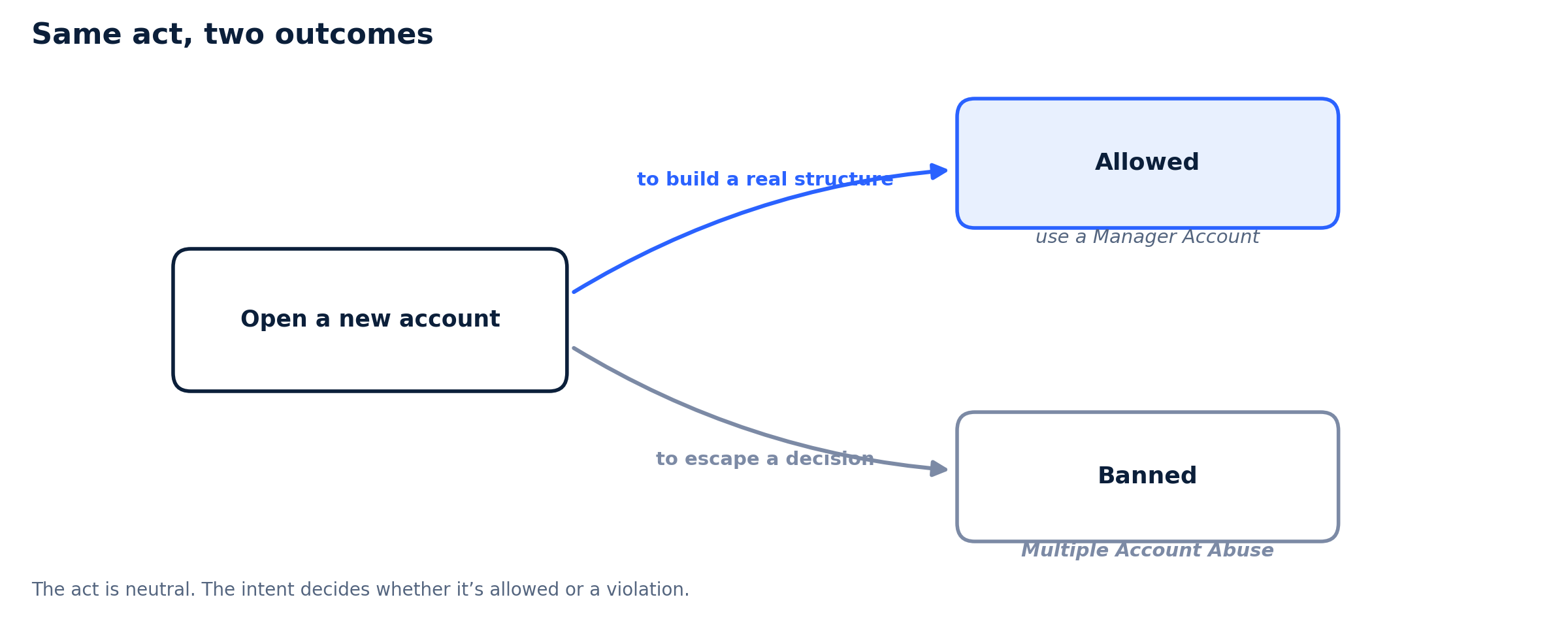
The honest answer turns on a word in the question that is easy to skip: justified. Opening a new Google Ads account is a routine, allowed thing that businesses do every day. Opening one to escape a suspension is a policy violation that gets the new account banned within hours. Same action, opposite outcome, and the difference is the reason behind it.
So the question is two questions wearing one coat. Are you building a legitimate structure, or escaping a decision? Google draws that line hard, and it built a product on one side of it and an enforcement category on the other. Knowing which side you are on is the whole game.
Start with the part most people get wrong. Having more than one Google Ads account is allowed, and Google made a tool for that purpose. The Manager Account, still known by its old name MCC, lets an agency or a company hold and run many accounts from a single login, with separate billing, reporting, and ownership for each. A product that manages thousands of accounts is not a product for a platform that bans multiple accounts.
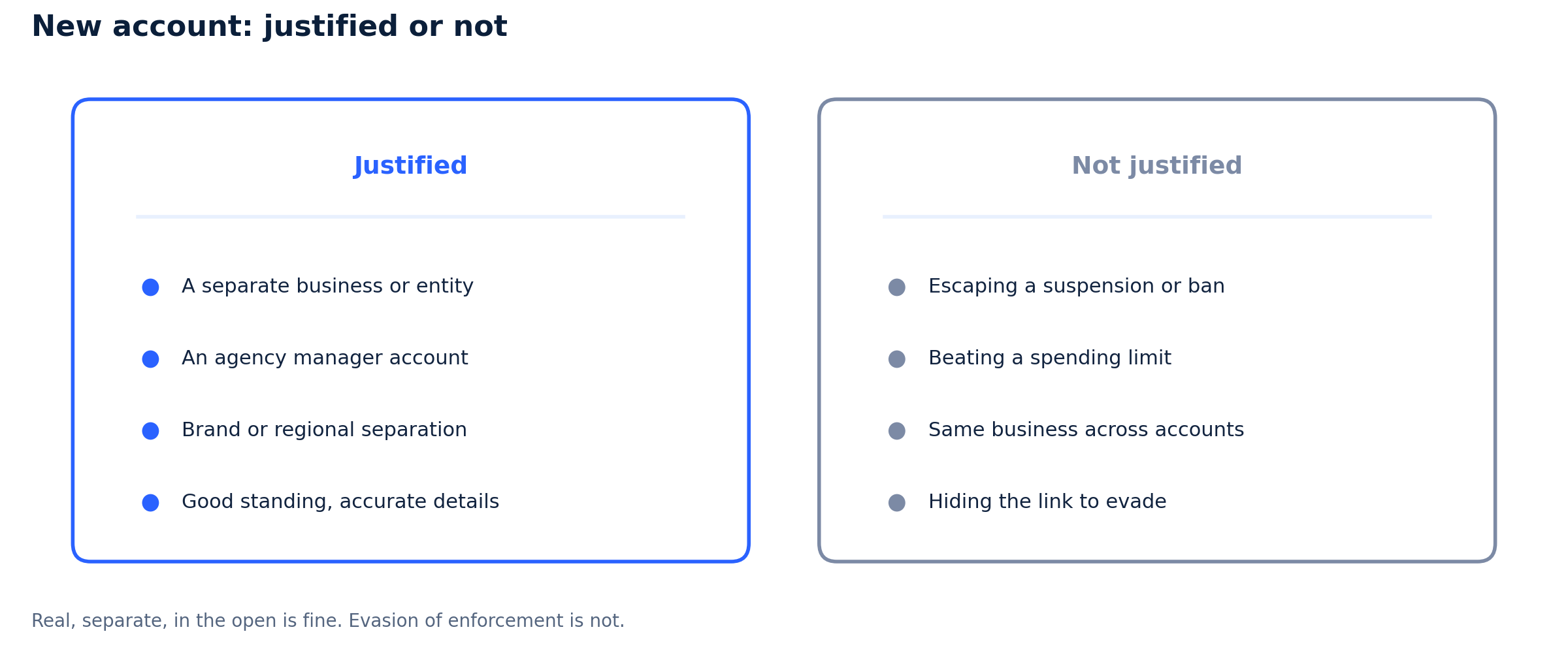
The legitimate reasons are ordinary. An agency gives every client a separate account for clean billing and ownership. A company with distinct brands or legal entities runs a separate account for each, so the books and the campaigns stay apart. An international advertiser uses country-level accounts for currency, language, and budget. A team keeps a test account away from live spend. In every one of these, the accounts are real, separate, and advertising in the open. Google does not penalize the number of accounts. It acts on what the accounts are used to do.
The other side has a name, and Google files it under its most serious policy. Multiple Account Abuse sits inside Circumventing Systems, the egregious category, and it covers using extra accounts to get around the rules rather than to run a real business. The clearest version is the one this site is built around: creating a new account after a suspension to keep advertising. Google treats that as an attempt to re-enter the system it just removed you from, and the new account is the violation.
The category is wider than the post-suspension case. Running the same offer or the same website across several accounts to crowd the auction counts. Opening accounts to spend past a limit counts. Spinning up many accounts in a short window, which the system reads as coordinated and suspicious, counts. Google detects the connection through shared payment methods, IP addresses, device fingerprints, domains, and business details, and when it does, it tends to suspend every linked account at once. One flagged account can take the rest down with it.
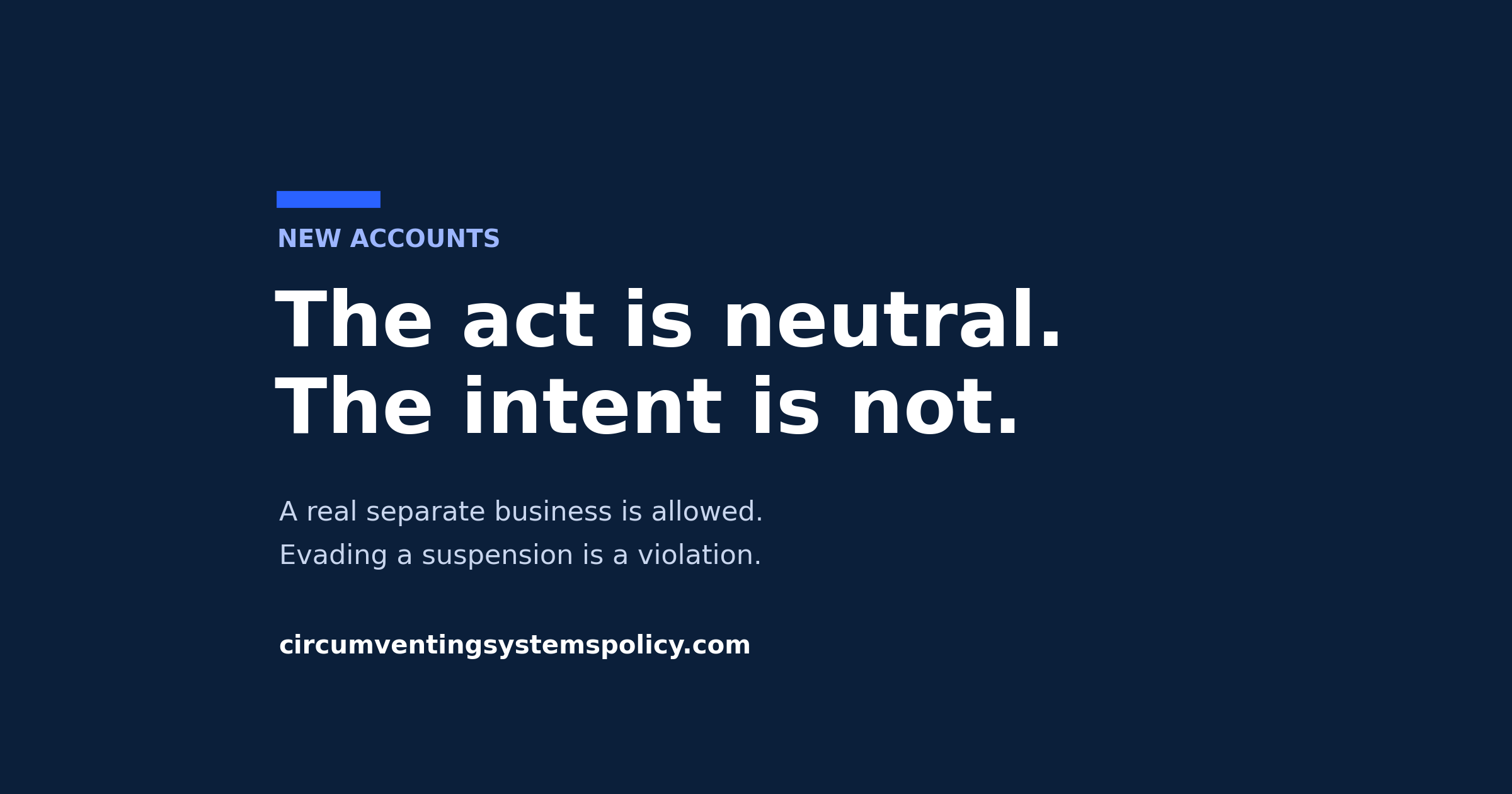
The act is neutral. The intent is not.
Google built the Manager Account to run many accounts at once. It built Multiple Account Abuse to ban accounts opened to evade a suspension or game the system. Opening an account is allowed. The reason decides whether it is a violation.
A whole industry exists to help people cross this line without getting caught, and it is worth naming for what it is. Anti-detect browsers, residential proxies, virtual cards, and rented agency accounts all sell the same promise: hide the connection so a second account for the same banned business looks like a stranger. Treat that promise with suspicion. Masking your fingerprint does not make the account legitimate. It removes the only innocent explanation you had left.
Think about how it reads if the masking fails, and it often does. A legitimate separate business has nothing to conceal. An advertiser routing each account through a different proxy and a different virtual card, to run the same project the platform already banned, has documented the intent to evade. The tooling that promises safety is the evidence of the violation. The compliant path never requires you to disguise who you are.
For the most common version of this question, the one asked the moment a Google Ads account suspended notice arrives, the answer is a clear no. Google states the compliant order in plain terms: reinstate the suspended account first, and do not create new accounts to replace it. A new account opened while the original is suspended is treated as circumvention, gets caught on the connection, and tends to stack a fresh permanent ban on top of the one you already had. It also signals to Google that you chose to evade rather than appeal, which does the original case no favors.
The instinct is understandable. The appeal is slow and opaque, and a new account feels faster than fighting the old one. It is a trap. The new account does not escape the suspension; it extends it across a second account and forecloses the cleaner route. The path back runs through the original account and its appeal, not around it.
One case sits in real gray, and it deserves an honest treatment rather than a slogan. Suppose the original account is banned for good, every appeal is exhausted, and there is no mistake left to show. Is a fresh start ever legitimate? It can be, under a strict condition: the new account has to belong to a new and separate business, with a different entity and a compliant model, not the banned operation wearing a new coat.
The test is continuity, not paperwork. If the thing that caused the ban is gone, the products, the practices, the claims, the site that violated the policy, then a new and compliant business is a new and compliant business. If the new account exists to run the same operation that got banned, a different logo and a different card do not change what it is, and Google's systems are built to see through that. The honest version of a rebuild changes the business. The dishonest version changes the disguise. Only the first one is justified, and even then it carries risk.
Put the evidence together and the answer splits in two.
|
Is creating a new Google Ads account ever justified? Yes, in the legitimate cases. A distinct business or legal entity, an agency manager account, brand or regional separation, a test account, or routine additional accounts for an advertiser in good standing are all allowed. Google built the Manager Account for this exact purpose, and the number of accounts is not the issue. When is it not justified? When the purpose is to get around a suspension, a ban, a spending limit, or detection, or to run the same business across accounts for advantage. That is Multiple Account Abuse under Circumventing Systems, Google detects the connection, and it tends to suspend every linked account. |
The honest answer is that the act of opening an account is neutral, and the intent behind it decides everything. Build a real, separate structure in the open, with its own entity and accurate details, and a new account is not just justified but ordinary, and a Manager Account is the right way to hold it. Open one to escape a decision, to outrun a limit, or to run the banned business in disguise, and you have not found a workaround; you have committed the violation Google is built to catch. After a suspension, the path forward is the appeal, not a second account. After a permanent ban, the only honest fresh start is a different and compliant business, not the old one renamed. Everything else is evasion with extra steps.
Weigh the source, because our position here costs us business. People ask us to help them open new accounts to get around suspensions, and we say no, because that is the violation, not the cure. We do not set up anti-detect browsers, supply proxies, or rent agency accounts to hide a connection, and we turn away anyone who wants that. What we do is the opposite: help legitimate advertisers reinstate the account they have, and tell people the truth when a new account would make things worse. If your need is a real separate business or an agency structure, the route is a Manager Account and accurate verification, and you do not need us for that. If your goal is to dodge a ban, no honest service should take the job.
Sort your situation into one of three before you do anything. If you have a legitimate need, several businesses, several clients, or several regions, open the accounts in the open and link them under a Manager Account. Give each one its real entity, accurate billing, and honest verification, and do not share assets or fake separation to make distinct accounts look unrelated, since that mimics the abuse pattern.
If you are suspended, do not open a new account. Reinstate the original first: find the trigger, fix it, document it, and appeal, in that order. A second account here stacks a permanent ban and weakens the case you still have. If you are under a permanent ban with appeals exhausted, treat a new account as legitimate only if you are building a different, compliant business in fact, and walk away from any tool that promises to hide the connection, because needing to hide it is the answer to whether it is allowed. If you operate in the EU or the EEA, use the statement of reasons and the out-of-court routes the law provides. This is general information about platform enforcement, not legal advice.