.png?width=2000&height=2000&name=Untitled%20design%20(4).png)
account suspended
google ads
Marketing

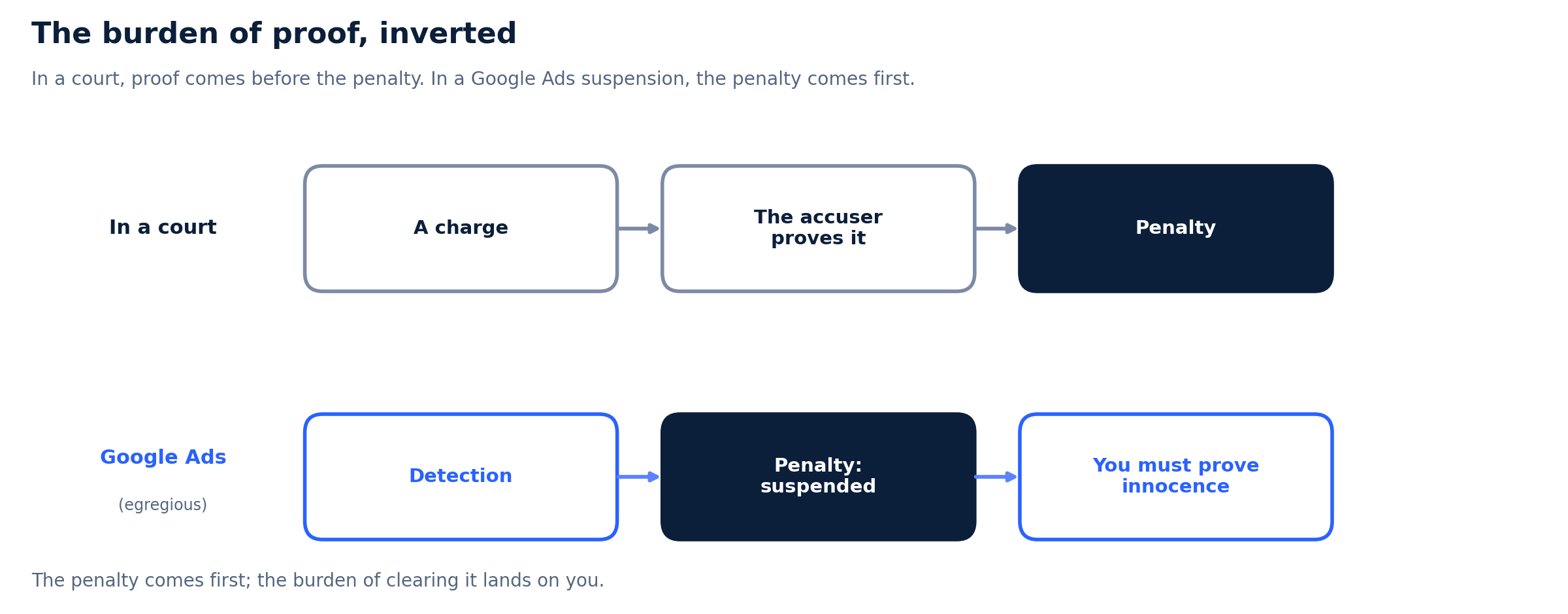
Read Google’s account suspensions page and it reads less like a help article than a charge sheet. An egregious violation triggers an immediate suspension, with no warning. The account stays suspended, treated as permanent, unless you appeal and win it back. Reinstatement comes only in compelling circumstances, such as a mistake. The structure puts the penalty first and the hearing second, and it leaves you to prove you did nothing wrong.
That structure is what people mean when they call Google Ads guilty until proven innocent. As a description of the experience, the phrase is accurate. As a legal standard, it asks the wrong question, because Google is not a court. Both halves matter.
Google’s own wording carries the burden of proof, and it carries it the wrong way. The policy tells a suspended advertiser to appeal if they believe they have not violated the rules. The move there is subtle and total: you arrive already labeled a violator, and the appeal is your chance to disprove it. Google does not open by proving the violation to you. You open by disproving it to Google.
The default compounds the problem. A suspended account counts as permanent unless you act, and Google reinstates accounts only in compelling circumstances. Inaction means the suspension stands. The advertiser who does nothing stays banned, which is the opposite of how a presumption of innocence works.
Then there is the matter of the charge. Google names a policy, Circumventing Systems or Misrepresentation or another, and links a general page, but it seldom identifies the specific action that tripped the system. You are asked to prove you did not do something, without being told what that something was. Proving a negative is hard. Proving a negative against an unnamed accusation is harder.
The evidence sits on one side too. Google holds the signals that triggered the suspension and does not share them. It publishes no error rate for any policy. For an egregious violation, you often get one appeal, so a single underprepared submission can end the account for good. The party with all the information sets the test, grades it, and keeps the margin of error to itself.
Permanent by default
Google’s own policy treats a suspended account as permanent unless you appeal and win reinstatement, which it grants only in compelling circumstances such as a mistake. The burden of proof sits on the advertiser.
The phrase is fair to the experience and unfair to the institution. Three facts pull against it.
Not every suspension lands without warning. For ordinary violations, Google runs a strike system, up to three strikes per policy, with penalties that escalate before a suspension. The immediate, no-warning version applies to egregious violations, the category Google treats as serious enough to act on first and review after. Most of the guilty-until-proven-innocent complaint lives in that lane, not across all enforcement.
Google is a platform, not a court. The presumption of innocence is a protection citizens hold against the state, with its power to jail and fine. A company deciding who may use its advertising network operates under its terms of service, not criminal procedure. Advertising on Google is a commercial privilege, and a private firm can withdraw it on suspicion, the same way a marketplace can suspend a seller while it investigates.
Scale and fraud make the speed defensible. Google suspended 24.9 million accounts in 2025 against a flood of AI-generated scam ads. A standard that required proof of guilt before any action would leave that fraud running while cases were built. Platforms act on probability and signals because the alternative protects the bad actor. Provisional suspension, paired with a right to appeal, is the trade most large platforms have settled on.
And the presumption is rebuttable. There is an appeal, Google says it uses both AI and human evaluation to decide it, and accounts do come back. Call it provisional enforcement with a path to reverse it. The exit exists, even when it is hard to reach.
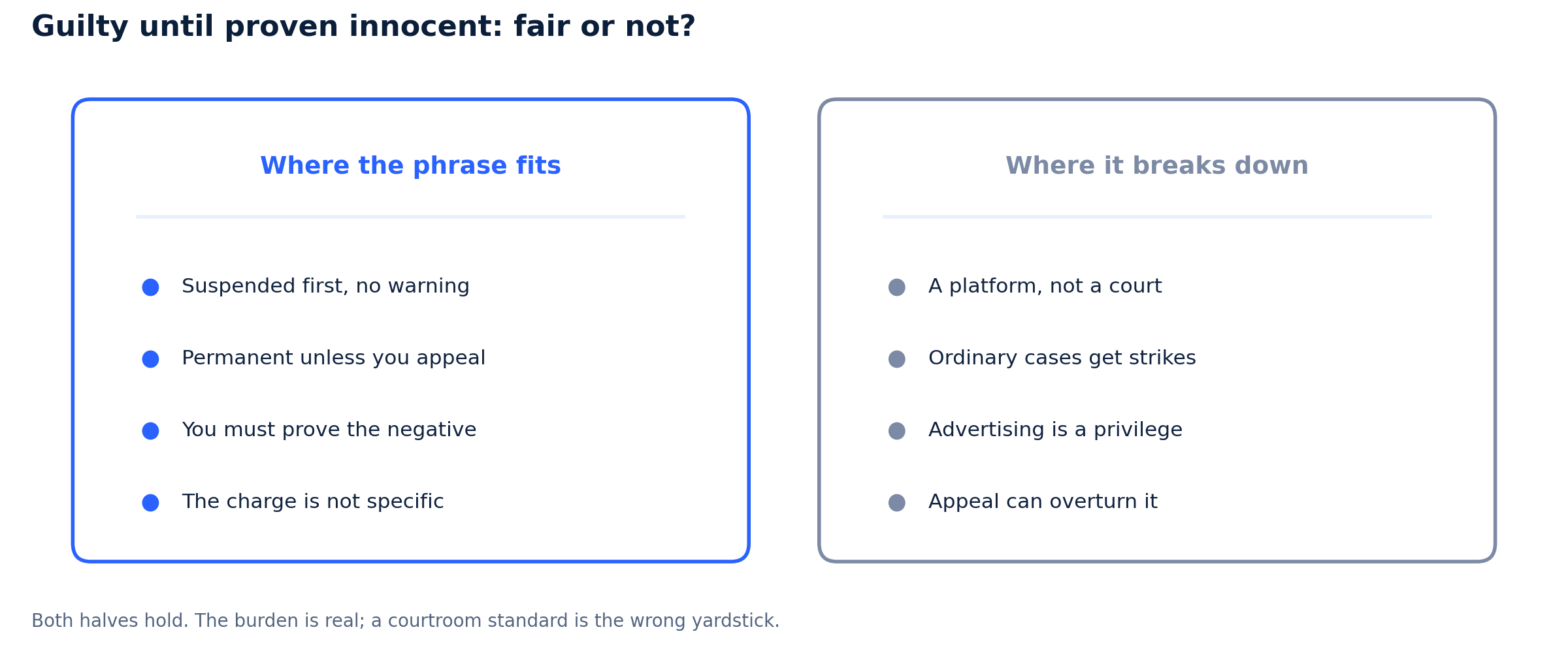
Grant every point above, and the complaint still has a core that holds. An inverted burden of proof can be fair, but only when the accused can carry it. Google’s process makes the burden heavy in three ways at once.
You have to prove innocence without the charge. The suspension names a policy and withholds the trigger, so your evidence aims at a target you cannot see. You often face an automated first reviewer that rechecks the same signals rather than weighing your explanation. And for egregious cases, you may get a single attempt. The burden is heavy, the information is poor, and the attempts are few. That combination is what turns provisional enforcement into something that feels like a verdict.
The pushback is real and growing. In the EU, the Digital Services Act requires platforms to give a statement of reasons and points suspended advertisers to formal redress, and the GDPR grants a right to human review of an automated decision. Google itself directs EU advertisers to those options. In November 2025 it reported cutting incorrect suspensions by more than 80% and resolving appeals faster. None of that flips the burden back. It makes the burden easier to carry, in some places more than others.
Put the evidence together and the answer splits in two.
Does Google Ads treat advertisers as guilty until proven innocent? As an experience and a burden of proof, yes. It suspends egregious cases on detection without warning, calls the account permanent unless you appeal, reinstates only in compelling circumstances, and asks you to disprove a charge it does not state in full.
Is that the right standard to judge it by? Not quite. Google is a platform, not a court; advertising is a commercial privilege; ordinary violations get strikes and warnings; and at fraud scale, provisional action with a right of appeal is defensible. The presumption is rebuttable.
The fair conclusion holds both. The burden of proof does sit on the suspended advertiser, and Google’s own wording puts it there. That arrangement is legitimate for a private platform fighting fraud at scale, on one condition: the appeal has to be a real one. An inverted burden is only just when the accused can see the charge, reach a human, and try more than once. Google has made the process faster and is being pushed by regulators to make it fairer. Until the charge is specific and the appeal is winnable, the phrase will keep fitting, because the people living through it are proving their innocence to a system that assumed otherwise.
Weigh the source. A firm that wins back suspended accounts has every reason to frame the system as stacked against the advertiser, since that framing sells the service. We have tried to argue it straight, which is why this article spends as long dismantling the courtroom metaphor as defending it. The harsh wording, suspension on detection, permanent unless appealed, reinstatement only in compelling circumstances, is Google’s own, quoted from its policy page. The defenses of it are ours, offered because they are true.
Accept the burden, then meet it. The system will not prove your innocence for you, so build the case yourself. Find the specific signal behind the suspension, a redirect, a second account, a billing change, a verification mismatch, and aim your appeal at that signal. Fix it before you appeal, since Google judges the state of your account, not your promise to change it. Attach timestamped evidence of the fix.
File one thorough appeal in place of several thin ones, and treat it as your only shot, because for an egregious violation it may be. If you operate in the EU or the EEA, use the Digital Services Act redress options Google points you to, and your right to human review under the GDPR. This is general information about platform enforcement, not legal advice.