.png?width=2000&height=2000&name=Untitled%20design%20(4).png)
account suspended
google ads
Marketing

A Google Ads suspension arrives with a policy name and little else. The notice cites Circumventing Systems, or Misrepresentation, or another rule, and stops there. You lose your main sales channel that morning, and the message never says which action triggered the decision or how to undo it.
That gap drives a fair demand: make Google explain. The question sounds simple, and three words inside it carry weight: who does the forcing, how deep the explanation runs, and whether the rule covers every suspension or carves out the fraud rings it exists to stop. The European Union has already answered part of this, so the debate runs further than most advertisers think.
Start with the strongest version of the yes. A bare policy name is not an explanation. You cannot fix a problem you cannot see, and you cannot contest a decision whose basis stays hidden. When Google names Circumventing Systems without naming the redirect, the second account, or the shared payment card behind it, the appeal turns into a guess. Due process means knowing the charge.
The power gap sharpens the point. Google holds the dominant share of search advertising, and for many businesses no real substitute exists. One automated decision can end the channel that pays the staff. A penalty that severe, imposed by a dominant platform, invites the same procedural floor that courts and regulators apply elsewhere.
That floor already exists in European law. The Digital Services Act requires platforms to give affected users a clear and specific statement of reasons when they suspend or terminate an account, to say whether an automated system made the call, and to point to an appeal, with every such statement filed in a public database. The Platform-to-Business Regulation goes further for business users, requiring a statement of reasons on a durable medium for any restriction, suspension, or termination, a thirty-day notice before a full termination, and reinstatement with restored data access when the platform reverses itself. Regulators have started enforcing it. Across late 2025 and early 2026, authorities in Germany, Italy, and France pushed major platforms into compliance. Forcing Google to explain is not a hypothetical. It is law on one continent.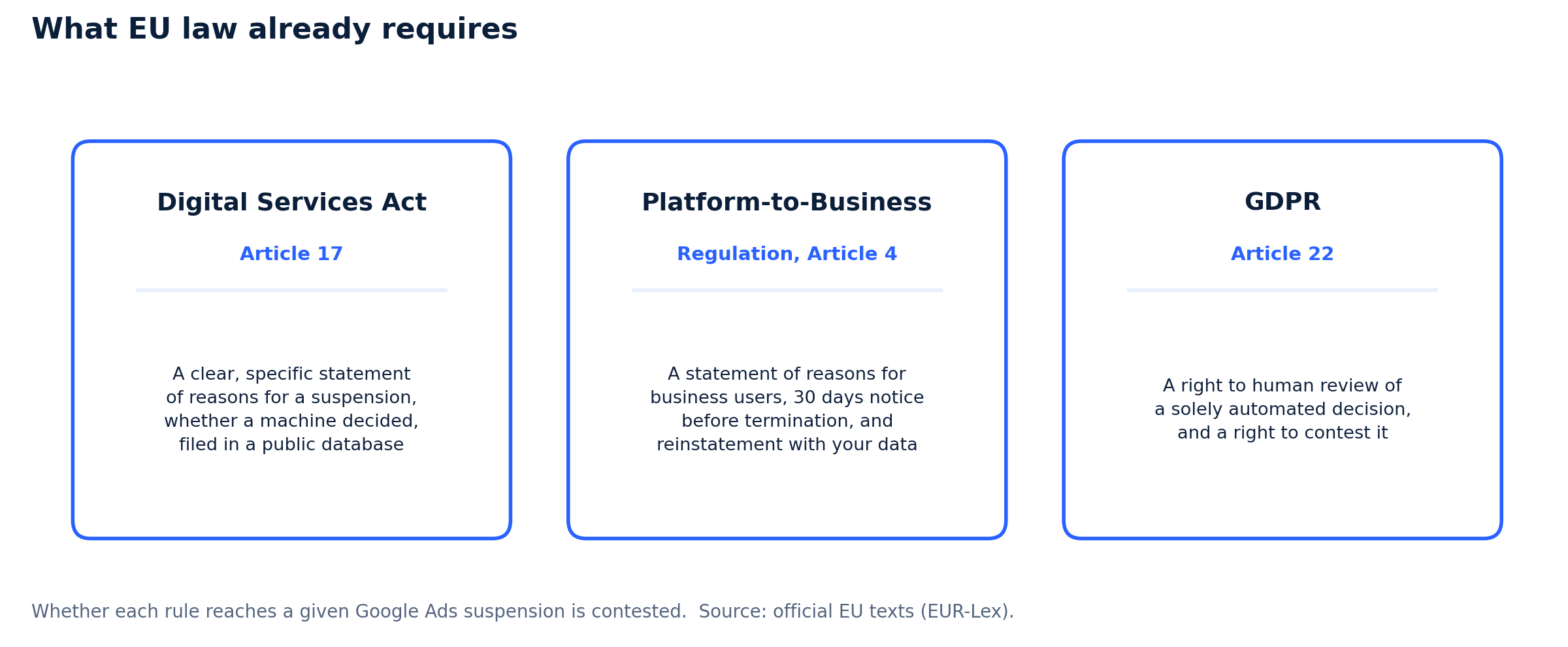
Already law:
The Platform-to-Business Regulation has required platforms to give business users a statement of reasons for suspensions since July 2020. The Digital Services Act extended the duty to account suspensions and added disclosure of automated decisions. EU regulators began enforcing both in 2025 and 2026.
A duty to explain also improves the decision. A system that must state a reason in language a business can read has less room for the lazy inference, the stale signal, or the match no reviewer would defend.
Now the strongest version of the no, which does not defend secrecy for its own sake. Google withholds the specific trigger on purpose. Publish the exact signal that caught an account, and the operators gaming the system learn what to change. Cloakers adjust the cloak. Ban-dodgers learn which identifier linked their accounts. The filter that protects users turns into a manual for beating it. Practitioners who handle suspensions every week describe this trade, and the European Union built the same logic into its own rules: the Digital Services Act exempts deceptive high-volume commercial content from the statement-of-reasons duty, the exact category where a detailed reason would arm the spammer.
Scale compounds the problem. Google suspended 24.9 million advertiser accounts in 2025 and 39.2 million the year before, and machines drive almost all of it. A specific, human-readable reason for each one is an enormous undertaking, and at that volume even a templated reason strains against the variety of real cases.
The technology resists clean reasons too. Many suspensions come from models that output a risk score, not a sentence. Demand a reason from a system that does not produce one, and you get a manufactured rationalization that can mislead more than a blank. The drafters of the GDPR appear to have seen this. The binding text guarantees a person the right to human review and to contest a solely automated decision. The explicit right to an explanation sits in Recital 71, a non-binding preamble, and the operative articles leave it out. Legal scholars have argued for a decade over whether that omission was deliberate. The safer reading is that lawmakers wanted contestability they could guarantee, and stopped short of an explanation they could not.
The word every carries the last objection. A mandate with no exceptions treats an active fraud ring and a confused florist the same way, and hands the first group the one thing it wants. A full account fits some suspensions and endangers others.
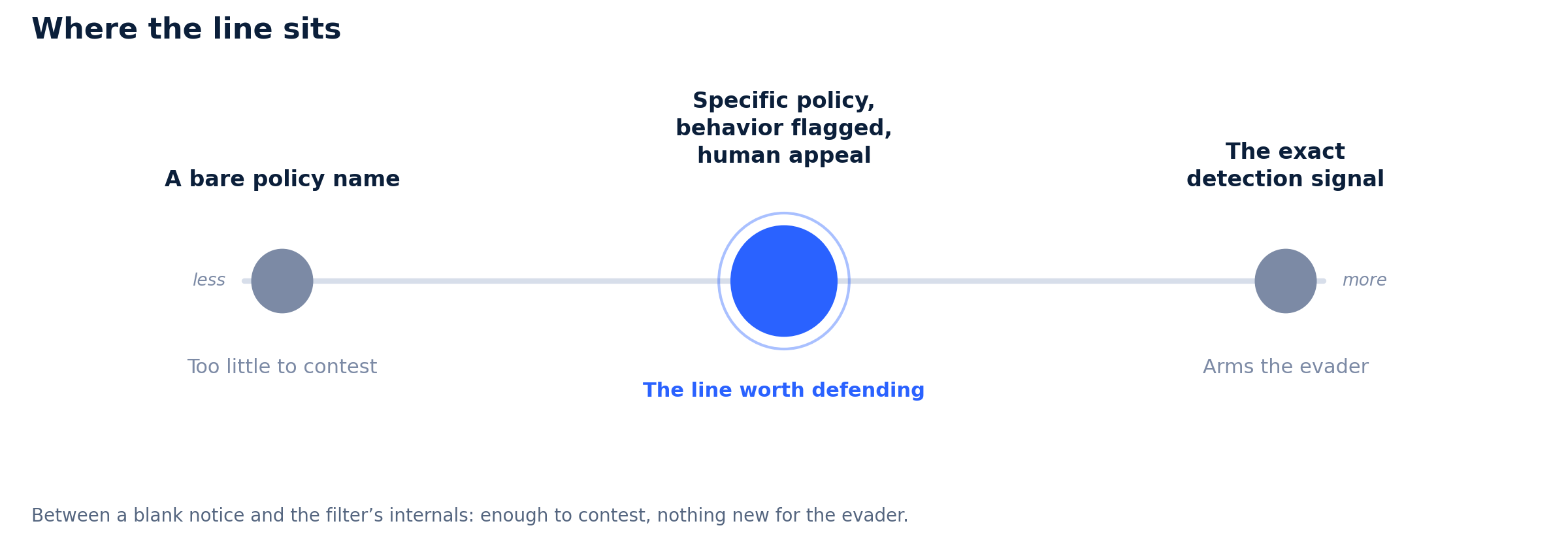
A wide gap sits between a blank notice and the filter’s source code, and the workable answer lives inside it. Google could name the specific policy and sub-category, not just the umbrella. It could state the type of behavior that flagged the account, a redirect or a multiple-account link or a verification mismatch, without publishing the feature weights that detected it. The notice could say whether a model or a person decided. And every appeal could reach a human who can overrule the machine. That package tells an honest business what happened and how to respond, and it keeps the detection internals out of the evader’s hands.
This sits close to what the European rules already demand. The Digital Services Act asks for a statement that is as precise and specific as reasonably possible under the circumstances, a standard rather than a blank check, and it pairs the reason with a route to challenge it. Adding a duty to expose the model’s inner logic would cross from fairness into self-sabotage. The line the law draws, a real reason plus a real appeal, is the line worth defending.
Google has already moved under pressure. In November 2025 the company reported cutting incorrect account suspensions by more than 80%, answering appeals 70% faster, and resolving 99% of them within 24 hours. It made those changes under regulatory and competitive heat, without a global law forcing it to explain every case.
The core complaint survives the improvement. The notice still names a policy without the specifics, and an automated reviewer still handles most appeals. A 24-hour answer that repeats the same vague reason solves the speed problem and leaves the clarity problem untouched. Faster and clearer are different goals, and Google has chased the first harder than the second.
Put the evidence together and the answer splits in two.
Should Google be forced to give a meaningful reason and a real appeal? Yes. The European Union already requires it through the Digital Services Act and the Platform-to-Business Regulation, and regulators began enforcing it in 2025 and 2026. Across most of the world the open question is enforcement, not principle.
Should Google be forced to explain every suspension with the exact trigger and no exceptions? No. The gaming risk is real, the volume is enormous, and lawmakers carved out high-volume commercial fraud and left a hard right to explanation out of the binding text. A precise-signal mandate would arm the operators the policy exists to stop.
The defensible standard sits between a bare policy name and the filter’s internals. Require the specific policy and sub-category, the type of behavior flagged, whether a machine or a person decided, and an appeal a human can overrule. Allow narrow exceptions for active fraud. That gives an honest business enough to understand and contest its suspension, and it gives the evader nothing new. Google holds the data to meet that bar. So far it has chosen speed over candor.
Weigh the source, this one most of all. A firm that diagnoses suspensions lives in part off the opacity we are criticizing here. If Google explained each suspension well, fewer owners would need someone to work out what went wrong. We are arguing against that interest, with the limits the evidence supports. And we have not claimed that Europe’s rules settle the matter for Google Ads. The reach of the Digital Services Act and the Platform-to-Business Regulation into a given Ads suspension, as opposed to a Search or Shopping action, remains contested, and we have flagged it rather than smoothed it over.
Your leverage depends on where you operate. Inside the EU or the EEA, the law gives you tools many advertisers never use. The Platform-to-Business Regulation entitles a business user to a statement of reasons and a route to clarify the facts through the platform’s internal complaint process. The Digital Services Act adds a statement-of-reasons right and disclosure of whether a machine decided. The GDPR gives you a right to human review of a solely automated decision that significantly affects you, and a right to contest it. Document the notice you received, or the absence of one, and invoke those processes by name.
Outside the EU, the legal footing is thinner, and the quality of your appeal carries more of the weight. Either way, this is general information, not legal advice. A lawyer in your jurisdiction can tell you which of these rights you can press.